
From Climate Progress, Nov 11 2010
Last month, NASA reported it was the hottest January-September on record. That followed a terrific analysis, “July 2010 — What Global Warming Looks Like,” which noted that 2010 is “likely” to be warmest year on record.
This month continues the trend of 2010 outpacing previous years, according to NASA:

It now seems pretty certain 2010 will outpace 1998, which currently ties for fourth hottest year in the NASA dataset (though it is technically described by NASA folks as tied for the second hottest year with 2005 and 2007).
Outpacing 2005, the hottest year on record, will be closer. In NASA’s surface-based dataset, we are unlikely to set the record monthly temperatures for the rest of this year; last month wasn’t close to the hottest October for NASA, though it was third warmest. We have entered a moderate to strong La Niña, which NOAA says is “expected to last at least through the Northern Hemisphere winter 2010-11.” That said, as you can see, the October anomaly (deviation from the 1951-1980 average) was higher than September, in spite of the La Niña.
NASA’s surface-based temperature record appears to be the most accurate, as I’ve noted many times (see Finally, the truth about the Hadley/CRU data: “The global temperature rise calculated by the Met Office’s HadCRUT record is at the lower end of likely warming”).
As I discussed earlier, last month, the hottest September in UAH satellite record, puzzled Roy Spencer with its “stubborn” temperatures. He now concedes that this year is likely to tie 1998 for the hottest year in the UAH satellite record (see “January-to-October tied for hottest in satellite record“).
For what it’s worth, here’s the latest UAH data, which, at least until it’s ‘adjusted’, shows what appears to be the warmest early November on record:

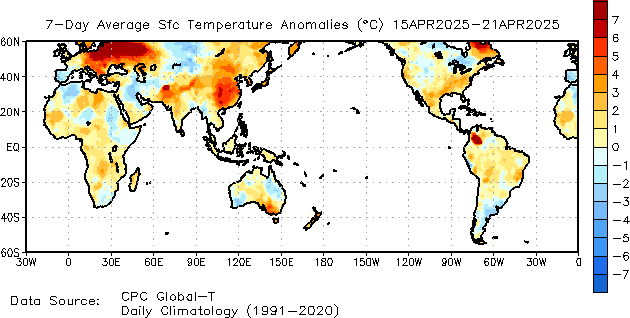
UPDATE: Michael in the comments directs us to this map of recent temperature anomalies from NOAA, which shows remarkably warm temperatures over much of Northern Hemisphere:
Finally, it bears repeating that the record warmth we are seeing this year is all the more powerful evidence of human-caused warming “because it occurs when the recent minimum of solar irradiance is having its maximum cooling effect,” as a recent must-read NASA paper noted:
- NASA: The 12-month running mean global temperature has reached a new record in 2010 — despite recent minimum of solar irradiance: “We conclude that global temperature continued to rise rapidly in the past decade” and “there has been no reduction in the global warming trend of 0.15-0.20°C/decade that began in the late 1970s.”
It is just hard to stop the march of human caused global warming — other than by sharply reducing greenhouse gas emissions.
Pingback: Knowledgeability vs ignorance - Page 36 - Politics & Current Affairs Forum