
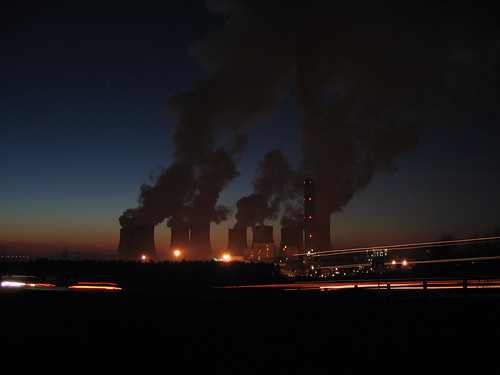
 A new study published in the Proceedings of the National Academy of Sciences from an international team of scientists (headed by Josep Candell of the Global Carbon Project, CSIRO) shows that the recent increases in CO2 are rising faster this decade than during the 1990’s (link to pdf). The authors blame rapid increases in a synergy of factors, primarily economic growth, fossil fuel usage and somewhat more worryingly a decline in the efficiency of natural sinks, such as ability of the oceans to absorb CO2 from the atmosphere (read more). It looks like we may be reaching the upper end of the modeling predictions (the 500ppm tipping point) sooner than anyone thought: these findings are alarming, and strongly imply that the UN Climate Report may already be out of date.
Someone yesterday reminded me of a great analogy similar to that of the rise in CO2 emissions: for example, if you start driving from point A to point B, and half-way there realise that you are driving north instead of south (and hence that you are likely to arrive in point C rather than point B), the only way of getting to point B is to stop and turn around – slowing down isn’t going to help the situation. Given the evidence presented in this paper – It is too late to alleviate or ‘slow down’ fossil fuel usage. And with that, do we need a global revolution in what we do rather than pretending we can ease our way out of this problem with waterdowned commitments and wishy washy policy (remember the ‘aspirational’ non-existent targets of APEC?).
Pingback: Climate Shifts » Blog Archive » IPCC release “Climate Change 2007” – the IPCC Fourth Assessment Report (AR4)